Why Interoception & Allostasis are More Important Than Anyone Realized
Dr. Weiniger’s Clinical Insights
A landmark fMRI study has mapped the brain’s command center for everything happening inside your body — a massively integrated system working around the clock to maintain physiological balance. Most of this regulation operates entirely outside conscious awareness, yet it profoundly shapes how patients move, feel, and heal.
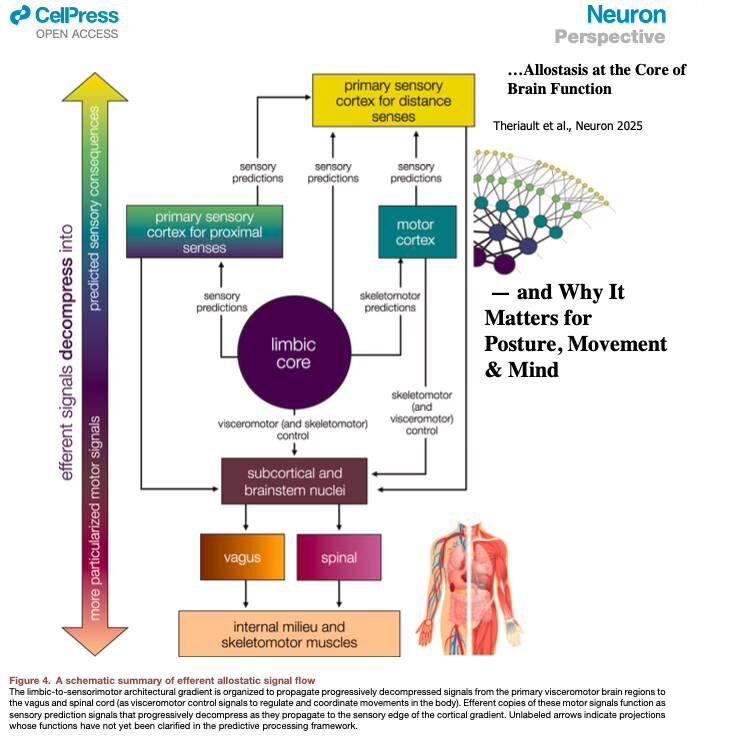
Led by neuroscientists including Lisa Feldman Barrett, Karen Quigley, Jordan Theriault, and colleagues, the study used ultra-high-resolution 7 Tesla brain imaging to visualize how the interoceptive nervous system (INS) actually works.¹ The research revealed how this system coordinates two well-known brain networks — the default mode network and the salience network — mapping their overlapping connections throughout the brain in unprecedented detail.
What Is This System?
Interoception is the body’s internal GPS — a continuous process of predicting your body’s state and energy requirements. This predictive monitoring regulates allostasis: the brain’s capacity to anticipate what the body will need and prepare to meet those needs before they become urgent. It reads subtle signals from organs, muscles, gut, and fascia to forecast the body’s state and energy demands — even before those needs reach conscious awareness.
Think of it as a sophisticated background program running constantly in the nervous system — integrating signals from organs and muscles, gut and fascia to keep metabolic and neurological fuel flowing. It’s why a patient’s heart races before a high-stakes situation, or why they become irritable and seek food before they’re consciously aware of hunger. Without this system — or when it becomes overloaded — the body shifts from proactive regulation to reactive crisis management.
Theriault sketch out how a complex, whole-brain phenomenon engages everything from the brainstem to the cortex. Only recently has imaging technology advanced enough to study it at this level of resolution. What’s particularly significant for clinicians: these networks aren’t limited to body regulation. They are equally crucial for cognition, emotion, pain processing, decision-making, and perception.
The bottom line: This interoceptive–allostatic system shapes how patients act — and how they move. Thoughts, feelings, and physical sensations aren’t separate systems; they’re deeply intertwined through this integrated whole. And it’s not only about survival — it supports performance, recovery, and growth.
The Clinical Reality
Research links disruptions in these interoceptive networks to chronic pain, fatigue, anxiety, cardiovascular disease, and depression. Barca shows how exercise improves interoceptive awareness — explaining the many studies supporting exercise, even above pharmacological interventions, as a first-line approach for chronic pain from biomechanic, psych and many other conditions 2,3.
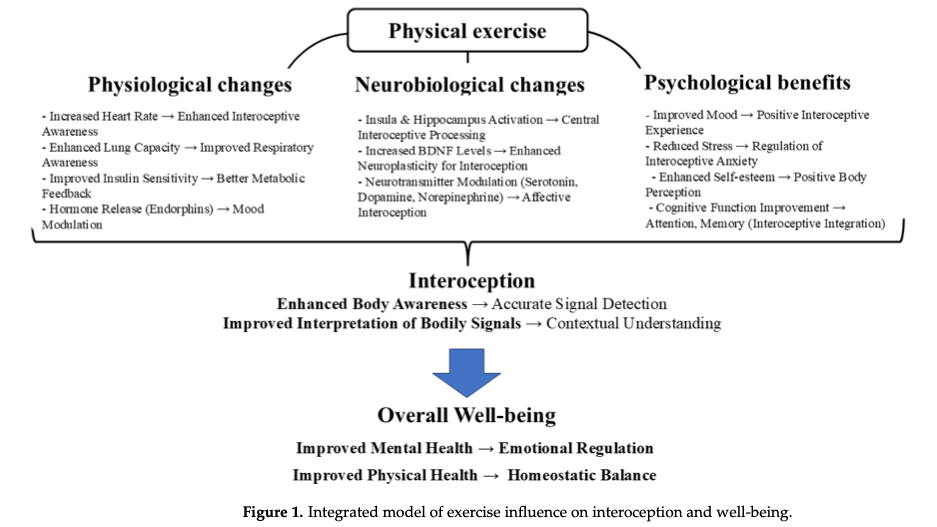
But the subtleties matter: It’s not only IF you move, it’s HOW you move. Moving with awareness and attentional engagement trains interoceptive accuracy differently than mindless, habitual movement. This is why structured approaches like StrongPosture® BAM (Balance, Alignment, Motion), alongside practices such as yoga, tai chi, and Pilates, can be genuinely transformative — particularly when coordinated with clinical support.
From Research to Clinical Practice
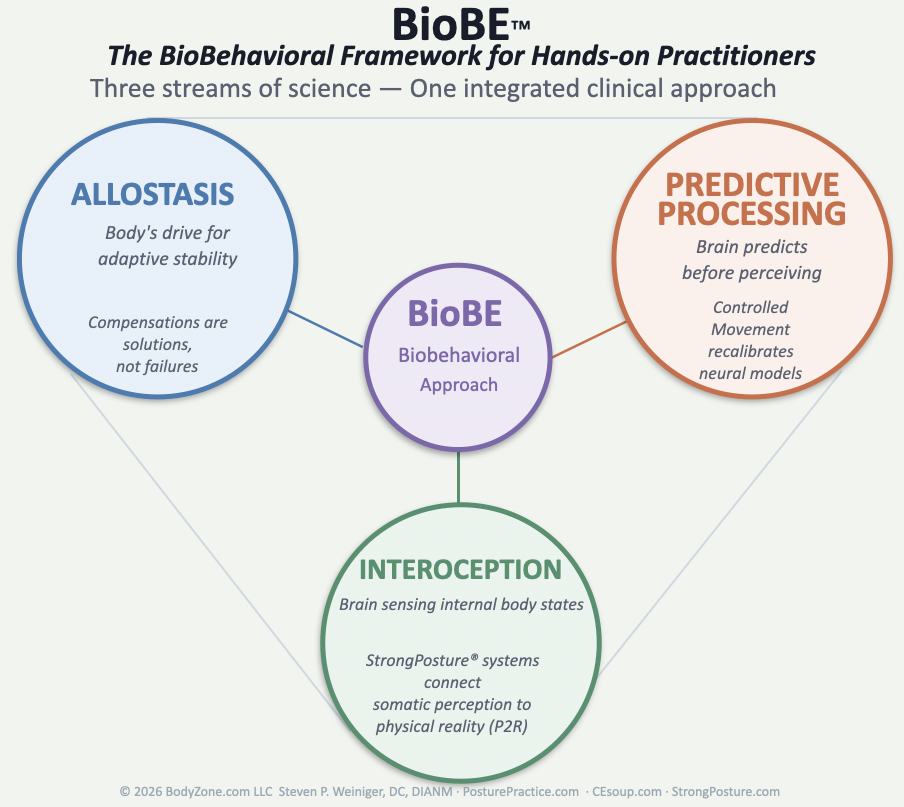
This research arrives at a meaningful moment for me personally, for my profession and indeed all NMS clinicians. If you’ve had patients whose pain or fatigue doesn’t respond the way the biomechanics suggest it should, interoceptive signaling and allostatic regulation are likely the hidden reasons.
I’ve been teaching about interoception and allostasis, posture and balance since before the pandemic, and I’m gratified at the feedback on my new course — Biomechanics & Interoception: A Biobehavioral Approach (BioBE).
Designed to introduce these ideas and bridge somatic neuroscience and behavioral science into an actionable clinical framework, BioBE teaches chiropractors, movement therapists, and bodywork practitioners to work with these systems rather than around them. From the common-sense foundation of our original StrongPosture® concepts and rehab protocols, BioBE is a 20 hour CE deep dive covering research foundations and, more importantly, practical applications.
Learn to apply cutting edge science and clinical protocols with BioBE. Build interoceptive body awareness and strengthen perceptual accuracy. Incorporate control of static balance, and then dynamic alignment and coupled whole-body movement control. Step by step you’ll deliver results- less pain, smoother, more efficient movement — and a new clinical pathway for healing, performance enhancement, and active longevity.
Ready to explore how to optimize your patients’ body–brain conversations?
Reference
¹ Zhang, J., Chen, D., Deming, P., Srirangarajan, T., Theriault, J. E., Kragel, P. A., et al. (2025). Cortical and subcortical mapping of the human allostatic–interoceptive system using 7 Tesla fMRI. Nature Neuroscience, 28(11), 2380–2391.
2 Barca, L. (2025). The Inner Road to Happiness: A Narrative Review Exploring the Interoceptive Benefits of Exercise for Well-Being. Healthcare (Basel), 13(16), 1960.
3 Núñez-Cortés, R., Nijs, J., Huysmans, E., Calatayud, J., Cruz-Montecinos, C., & Suso-Martí, L. (2026). Vigorous physical activity shows the most consistent association with quality of life compared with smoking and body mass in adults with osteoarthritis and