
Your Posture Isn’t Normal…But it’s Yours
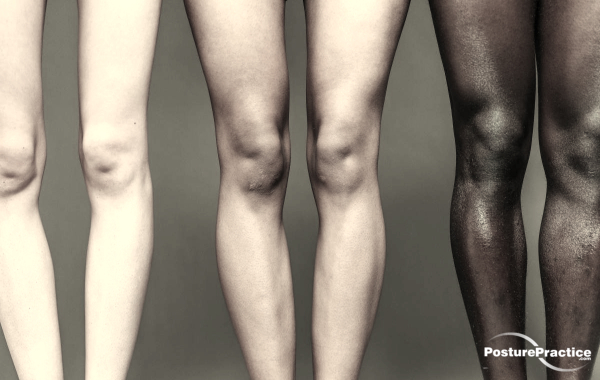
A 2024 scoping review landed with the kind of headline that makes some pros who talk about posture squirm: The Standard Posture Is a Myth.
The author reviewed the evidence on normative posture standards and found exactly what the title suggests — that applying a fixed postural standard to individual patients produces “numerous false positives, particularly in older adults,” and that “posture assessment must be based on a global, individualized examination, including the subject’s natural posture, rather than being subordinated to a particular standard of comparison.” (Barra-López, 2024)
The conclusion is correct. And it misses the point entirely.
The Argument Proves Too Much
Let’s be clear about what Barra-López actually demonstrated: comparing an individual’s posture to an externally defined “ideal” posture is clinically unreliable. The cervical lordosis that’s pathological in one person is completely functional in another. The shoulder height asymmetry that looks alarming on a reference grid may be that person’s lifelong normal. Applying a universal standard creates false positives, stigmatizes variation, and misdirects treatment.
All true. And none of it means posture doesn’t matter.
The error in the “posture isn’t a problem because there’s no normal posture” argument is a logical one: it conflates two very different clinical questions.
Question 1: Is this patient’s posture abnormal compared to a population standard? Question 2: Is this patient’s posture working well for them — and is it getting better or worse over time?
Barra-López answered Question 1. The answer is: the question itself is the wrong question.
Question 2 is the right question. And it’s the one posture assessment actually needs to answer.
Your Posture Is Your Baseline
When a patient walks into a clinic complaining of chronic neck pain, fatigue, or recurring low back episodes, the relevant clinical question isn’t whether their head-forward position matches a published norm. It’s whether their posture has changed from their own baseline — and whether that change correlates with their symptoms, their function, and ultimately- their clinical response to any trial of care.
A longitudinal, individualized posture record doesn’t compare the patient to anyone else. It compares the patient to themselves. Their unique body, over time. A visual benchmark that can then be correlated with their own perception of their posture as well.
This is a completely different — and clinically legitimate — use of posture data.
Think of it the way we think about blood pressure. The standard ranges exist, but what matters most in clinical practice is the trend: is your pressure higher than it was last year? Is it responding to the intervention? Has it stabilized? A single snapshot compared to a population average tells you relatively little. A sequence of measurements taken on the same individual, under comparable conditions, tells you something real.
Posture works the same way.
The Hidden Problem: The Gap Between Perceived and Expressed Posture
There’s a second dimension that the normative-standards debate misses entirely — and it may be the most clinically important one.
When we photograph a patient’s posture and show them the image, something interesting happens: most are quite surprised at what they see! The posture they think they hold rarely matches the posture the photo captures. They thought they were standing straight. The photo shows a head that’s two inches forward of their shoulders. They thought their weight was evenly distributed. The unipedal photo shows a marked lean to one side.
This gap — between perceived posture (a product of what the nervous system predicts based on sensory inputs– visual, vestibular, proprioceptive as well as interoceptive) –and expressed posture (what the body actually does) — is not a measurement artifact. It’s a signal of the accuracy and alignment of the brain’s internal sensory signaling with the internal model and the reality of our body. The signal is what scientists and clinicans refer to as the awareness and accuracy of our interoceptive sense.
Interoception is called “the Hidden Sense” because it’s subtle, processed in a deep brain area called the insula. Only recently has technology allowed researchers to track it’s profound connections between what we feel and what we do. Studies show significant problems -physical as well as behavioral and emotional–happen when there’s a mismatch between this perceived internal model, our somatic schema, and the physical reality of our body.
A landmark 2026 study (ALMohiza & Reddy, PLoS One) found that interoceptive posture awareness scores independently predicted balance outcomes in stroke patients — better even than proprioception scores. Patients whose internal sense of their own body position was more accurate had better postural control, less sway, and more symmetrical weight-bearing.
Have you ever stood sideways in front of a mirror, or had someone snap a photo, and winced at what you saw. Rounded shoulders. Head forward. Hips shifted. You made a mental note to “work on it” — and then life happened, and nothing changed. This same principle applies across the NMS population. The patient who can’t feel their own postural asymmetry will unconsciously re-express it the moment conscious attention is withdrawn.
Even with cueing, without precise individualized cuing, the patient who can’t feel their own postural asymmetry will unconsciously re-express it the moment conscious attention is withdrawn. In addition, patient who doesn’t know their head is forward rarely improves alignment simple on being told to move it backwards and align. The most common response is to lean the torso forward a bit, and extend the cervical spine.Correcting the expressed posture without training the perceived posture is treating the symptom while leaving the mechanism intact.
IPP: Not a Normative Tool — A Personal Tracking System
The Interoceptive Posture Picture (IPP) protocol was developed to address exactly this distinction. It is not a tool for measuring deviation from a standard. It is a tool for documenting and tracking an individual’s posture — and for revealing the gap between what patients perceive and what they actually express.
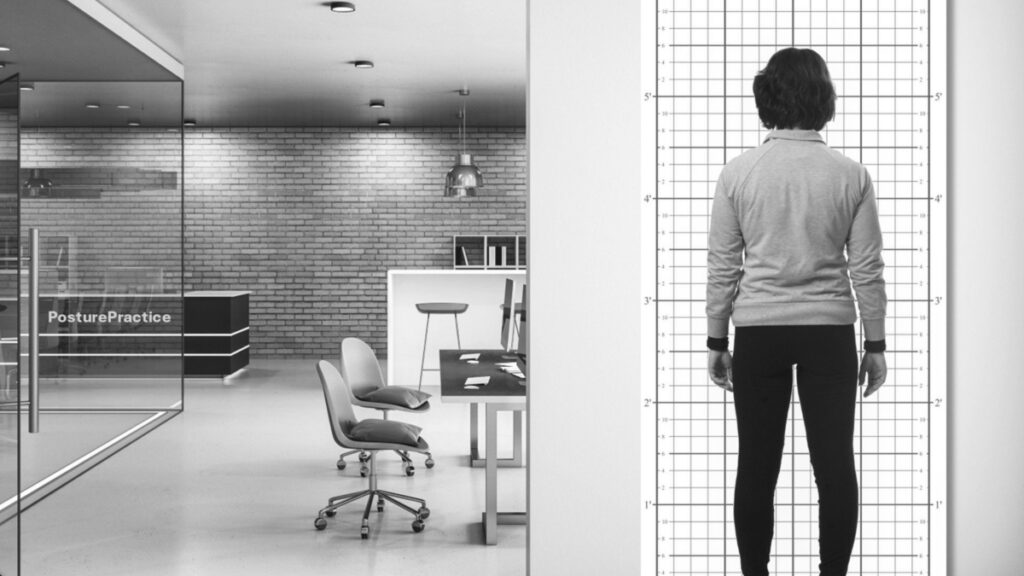
The protocol uses four standardized photos taken against a PostureZone grid — two in bipedal stance (front and side), two in unipedal stance (front and side). The grid is not a normal template. It functions as a gravity-line reference, providing consistent conditions for comparison within the same patient over time. The unipedal images reveal asymmetries and compensations that symmetric, supported stance conceals.
Crucially, before the patient sees their images, they’re asked to describe what they expect to see. That question surfaces the interoceptive gap directly. When a patient who believes they’re standing symmetrically sees a photo that shows a dramatic lean, that moment of visual feedback is not pathologizing — it’s informative. It creates the prediction error the nervous system needs to update its model.
Serial IPPs taken over a course of care answer the question Barra-López correctly identified as the right one: not “is this person’s posture normal?” but “is this person’s individualized posture — their posture — changing in a meaningful direction?”
(See: Weiniger et al., Frontiers in Neuroscience, 2024. PMID 38638696)
Building Better: @Focus, P2R and the StrongPosture® Protocols
If IPP reveals where the patient’s interoceptive model is inaccurate, StrongPosture® exercise is the clinical protocol for correcting perceptions towards reality…P2R for short. The progression is deliberate and sequential:
1. Interoceptive Awareness: Learning to Feel What’s Actually There Before a patient can improve their posture, they need an accurate internal sense of it. StrongPosture® B.A.M. (Balance, Alignment, Motion) protocols begin with directed attention — training the nervous system to register body position when attention is focused on simply standing tall, and then directed along the kinetic chain. That attentional focus (@Focus for short) on feeling subtleties emphasizes interoceptive sensations before attempting to make changes. This is where most exercise programs fail: they load movement onto a nervous system that doesn’t yet have an accurate model of its starting position, without awareness of the hidden sense.
2. Static Balance: Controlling the Base With growing weighting of interoceptive awareness and directed efforts, the patient learns to control their body in static one-leg balance with greater accuracy. Unipedal balance training is particularly important because it removes bilateral compensation strategies, requiring the nervous system to manage its postural model in conditions that expose asymmetry. Exploring and correlating perceived and expressed single-leg stand is a proven strategy to reduce the prediction error and discover new somatic patterns of equilibrium.
The limits of maintaining balance is the edge where learning occurs. From their alignment and then core medicate motor control can be addressed.
What “Better” Actually Means
Rejecting the normative posture standard is the right call. But rejecting posture assessment as a clinical tool — because there’s no single ideal to compare against — is throwing out the clinical question along with the invalid answer.
Your posture isn’t normal. It isn’t supposed to be. There’s no universal template your nervous system is deviating from. What there is: a starting point that is yours, a direction of improvement that is measurable, and a gap between what your nervous system predicts and what your body actually does — a gap that can be narrowed, tracked, and progressively closed through individualized care.
That’s not pathologizing variation. That’s honoring it.
FOR CONTINUING EDUCATION: → Biomechanics & Interoception – A Biobehavioral Approach
FOR PROFESSIONALS→ Explore CPEP® Posture Specialist Certification
FOR PATIENTS: → Learn about StrongPosture® exercise for interoceptive retraining
References
- Barra-López ME. “The standard posture is a myth: a scoping review.” J Rehabil Med. 2024;56:jrm41899. https://doi.org/10.2340/jrm.v56.41899
- ALMohiza MA, Reddy RS. “Relationship between postural and kinesthetic awareness, static balance, and weight-bearing asymmetry in individuals with chronic stroke.” PLoS One 21(1):e0341001 (2026). https://doi.org/10.1371/journal.pone.0341001
- Weiniger, S. P., & Schilaty, N. D. (2024). Interoceptive posture awareness and accuracy: a novel photographic strategy towards making posture actionable. Front Neurosci, 18, 1359594. https://pubmed.ncbi.nlm.nih.gov/38638696/