
App Training Revolution: A Critical Look
A recent Wall Street Journal article asked, “Can a Fitness App Replace Your Personal Trainer?”[1]. While celebrating the flexibility and cost savings of fitness apps, the article failed to address a crucial warning: “Weak posture awareness sets up injuries- short term, and over the long haul”[2]. Without an in-person coach to spot our misperceptions about where our body is, and how we are moving, mistakes occur…and over time accumulate.
The Form Fatigue Factor
The problem with self-guided workouts isn’t just about learning proper form—it’s about maintaining that dynamic postural alignment pattern when it matters most. Clinical studies show that fatigue inevitably causes our posture and form to break down.[2] You maintain good form until suddenly, you don’t. And typically, this happens precisely when you’re pushing your limits—the moment when proper form matters most.
The Compensation Spiral
This creates a dangerous feedback loop. When fatigue sets in, our bodies naturally compensate by relying on our strongest muscles and most comfortable movement patterns.[3] Think of it like water flowing downhill—it always takes the path of least resistance. In exercise, this means our stronger muscles get stronger while our weaker muscles fall further behind.
The Last Rep Paradox
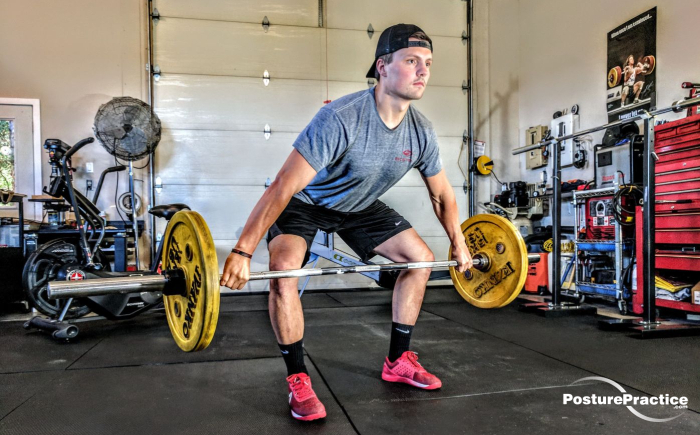
What makes this particularly insidious is that the most significant muscular benefits of strength training come from those final, challenging repetitions—the ones where your form is most likely to falter.[3] When you’re struggling to complete those last few reps, your body instinctively finds ways to make the movement “easier.” Maybe you shift your shoulder slightly back, or perhaps your hips compensate in a way that feels natural but tends to stress the weakest link in the kinetic chain. Suboptimal patterns are trained and thus strengthened.
Hidden Cost of Compensation
These compensations might seem minor, but they can have major consequences. While your primary muscles—the ones you’re trying to target—might still get their workout, the smaller stabilizer muscles get shortchanged.[3] These smaller muscles might not be the showstoppers, but they’re crucial for controlled, symmetrical movement patterns that prevent injury and promote balanced strength development.
Think of your body as a complex chain of interconnected links. When one link weakens, the entire chain adapts—not always in ways that serve your long-term fitness goals. Without expert oversight, these subtle compensations can become ingrained habits, potentially leading to strength imbalances or even injury over time.
The StrongPosture® Solution
This is precisely why StrongPosture® training should be an integral part of both exercise routines and clinical rehabilitation.[2] By focusing on developing awareness and control of posture and movement patterns, StrongPosture® training helps identify and correct these subtle compensations before they become problematic. It provides the foundation for proper form during exercise. More accurate awareness and fluid control towards symmetry lets your workouts truly strengthen the entire kinetic chain, not just your dominant muscle groups.
Whether you’re an athlete pushing for peak performance or anyone recovering from injury, incorporating StrongPosture® principles helps maintain balanced, functional strength and prevents the vicious cycle of compensation that often undermine your fitness goals. In essence, it’s not just about being strong—it’s about being strong with awareness and control of how you balance, align and move. We call that BAM!
References:
- Nguyen, Nicole. “Can a Fitness App Replace Your Personal Trainer? We Find Out.” Wall Street Journal, January 27, 2025.
- Weiniger, S. (2008). Stand Taller-Live Longer: A Posture & Anti-aging Strategy. BodyZone Press.
- Penedo, T., Polastri, P. F., Rodrigues, S. T., Santinelli, F. B., Costa, E. C., Imaizumi, L. F. I. et al. (2021). Motor strategy during postural control is not muscle fatigue joint-dependent, but muscle fatigue increases postural asymmetry. PLoS One, 16(2), e0247395.